1. Introduction
The rapid pace of industrial and technological transformation requires equally swift adaptation of skills and knowledge. However, universities often face a “structural lag,” resulting in a widening gap between talent cultivation and the evolving needs of industry (Papuraj et al. 2025). This lag, driven by internal barriers, limits universities’ ability to respond effectively to industry needs when developing educational programs with real-world applications. Such barriers include outdated curricula, inflexible program structures, limited practical training platforms, and insufficient industry experience among faculty.
Externally, weak industry participation, insufficient policy incentives, and ineffective interaction mechanisms exacerbate challenges and lead to a persistent mismatch between talent supply and demand (Liu et al. 2015; Ma and Guo 2018; Sun 2018). Additionally, cultural and institutional differences between industry and education, unequal distribution of benefits, and limited policy support further reduce the effectiveness of collaboration (Liu et al. 2021; Tang et al. 2021; Li 2025).
To address these challenges, governments and universities worldwide have increasingly emphasized industry–education integration as a key strategy to bridge this gap between education and industrial needs (OECD 2021; Global Education Monitoring Report Team 2023). According to the 2023 National Report on the Development of High-Quality Farmers, only about 15% of farmers have obtained professional agricultural technical titles, with notable shortages in emerging fields such as precision agriculture (Liu and Ma 2025). While labor shortages in the agricultural sector may be influenced by low wage incentives, for students who do enroll in agricultural programs in higher education, a misalignment between university curricula and industry needs can hinder their transition into sector employment after graduation.
While a tremendous number of industry–education integration efforts have been undertaken in China, the persistent “structural lag” in higher education continues to hinder their effectiveness. Therefore, strengthening universities’ adaptive capacity and tailoring integration mechanisms to specific regional industry needs is essential for achieving effective industry–education collaboration. This study examines how higher education systems can adapt to ongoing industrial transformation using a case study of one agricultural university in China.
Qingdao Agricultural University (QAU), located in Shandong Province, is an application-oriented agricultural institution with strong disciplinary foundations. It is situated in one of China’s leading agricultural regions and is a national hub for agro-processing and the agricultural machinery industries. Its geographic location and academic strengths position QAU as a relevant case for examining how regional agricultural universities align talent cultivation with industrial transformation under China’s National Rural Revitalization Strategy. Using grounded theory, this research investigates the mechanisms that enable successful industry–education integration programs at QAU. It also analyzes how innovative knowledge that meets industry needs is generated within this process. Specifically, this research examines the mechanisms underlying successful industry–education integration and their interaction with local industry, government, and society. It develops a theoretical model to explore how these mechanisms shape curriculum design, faculty engagement, student training, and instructional feedback.
The results of this study indicate that the successful programs at QAU follow the Mode 3 knowledge-production framework in generating new knowledge, while their mechanisms align with the Quadruple Helix Innovation Ecosystem. Together, these approaches strengthen the university’s capacity for talent cultivation and enhance its ability to respond to industry needs and support local economic development. By aligning university strengths with regional industrial needs, the study contributes to a deeper understanding of how universities can expand their role in regional innovation, industrial upgrading, and sustainable economic development. The findings also provide practical guidance for similar institutions seeking to improve the relevance and effectiveness of their talent cultivation initiatives.
2. Background and Literature Review of Industry–Education Integration
This section provides the contextual and theoretical background for the study. It first reviews the policy development of industry–education integration in China and then discusses the relevant literature and theoretical perspectives that inform the analysis.
2.1. Industry–Education Integration Policy in China
In China, industry–education integration has become a central strategy in higher education reform, driven by the national goal of cultivating innovative and application-oriented talent. Since 2017, a series of policy initiatives has been introduced to address the growing demand for high-quality human capital amid rapid technological advancement and industrial transformation.
The report from the 19th National Congress of the Communist Party of China first proposed to “deepen industry–education integration and university–industry collaboration,” marking a policy shift from expansion of higher education to improving its relevance and service to industry. Soon after, the State Council issued “Several Opinions on Deepening Industry–Education Integration,” identifying industry–education integration as a critical measure for advancing institutional reforms in higher education and fostering innovation-driven growth.
Following the 2017 policy initiatives, the next stage of reform emphasized regional coordination. In 2019, the National Pilot Implementation Plan for Industry–Education Integration established pilot cities to advance industry–education integration (Ministry of Education of the People’s Republic of China 2019). It sought to align regional industries with local higher education institutions, promoting joint development through targeted policy guidance and financial incentives. This marked a policy shift from conceptual promotion to practical implementation, embedding industry–education integration within local economic structures.
The subsequent stage reinforced the synergy between education, science, and industry. The report of the 20th National Congress of the Communist Party of China reaffirmed the importance of advancing “industry–education integration and the science–education synergy” (Xi 2022). It called for leveraging policy frameworks to create a mutually reinforcing relationship, using education to support industry and industry to assist education, thereby fostering a model of coordinated and symbiotic development.
Recent policies have further formalized this integration. The Opinions on Promoting the Reform of the Modern Vocational Education System advocated the establishment of integrated cities, industrial colleges, and mentor systems through joint curriculum design between higher education institutions and industry partners (General Office of the Communist Party of China Central Committee and General Office of the State Council 2022). Following this, the Action Plan (2023–2025) set clear goals to establish 50 pilot cities, engage over 10,000 integrated industry partners, and develop high-quality training sites (National Development and Reform Commission et al. 2023). Most recently, the Notice on Strengthening City-Level Industry–Education Consortia encouraged deeper partnerships between universities and industrial parks to consolidate these reforms (General Office of the Ministry of Education 2024).
2.2. Efforts and Challenges in Industry–Education Integration at Qingdao Agricultural University
China’s national policies on industry–education integration have created a structural foundation that enables universities to contribute more actively to regional innovation and workforce development. Agricultural universities have been positioned as strategic actors in advancing agricultural modernization and rural revitalization. Within this policy context, Qingdao Agricultural University (QAU) has actively advanced industry–education integration through a series of collaborative programs in talent cultivation, applied research, and practical training. As an application-oriented agricultural university serving a major agricultural region, QAU provides a useful case for examining how such integration is implemented in practice.
In recent years, QAU has strengthened partnerships with industry and public organizations to deepen collaboration in talent cultivation and has launched several successful programs to enhance industry–education integration. Its talent cultivation model emphasizes practical skills, innovation capacity, and social responsibility through jointly designed curricula, applied research initiatives, and experiential learning programs. Internally, the university has strengthened hands-on learning by introducing industry mentors and incorporating project-based learning. These initiatives align curricula with industrial demands and enhance students’ practical skills, innovation capacity, and employability. Beyond individual student outcomes, such integration contributes to regional industrial transformation, enabling universities to play a proactive role in economic development while preparing students to meet the evolving demands of modern industries.
Despite these efforts, challenges persist at QAU, reflecting broader issues faced by many agricultural universities. Faculty members often lack direct industry experience, curriculum renewal can be slow, and institutional rigidity constrains responsiveness to rapidly evolving industrial demands. Moreover, industry participation is sometimes limited or short-term, leading to inconsistent engagement and weak strategic alignment. These challenges point to an ongoing structural mismatch between educational provision and the dynamic needs of technology and the market.
Addressing these challenges requires agricultural universities to move beyond passive participation toward a more proactive role in talent development. This involves creating flexible, collaborative frameworks that engage multiple stakeholders and enable education and industry to co-evolve. In this context, the successful industry–education integration programs at QAU provide valuable cases for exploring how agricultural universities can better align talent cultivation with regional industrial transformation.
2.3. Grounded Theory
Grounded theory is a qualitative research method that uncovers the underlying logic from systematic analysis of empirical data (Strauss and Corbin 1998; 1990; Glaser and Strauss 1999). It relies on multiple forms of qualitative data—such as interviews, documents, and field materials—to generate concepts and gradually extract insights to reveal underlying relationships within the data. Researchers systematically code and compare data, refine emerging themes, and deepen analysis through iterative processes. Through theoretical sampling, the analysis continues until theoretical saturation is reached, enabling the development of new conceptual frameworks. Compared with traditional text analysis methods, grounded theory facilitates more structured theory building and efficient data interpretation, contributing to its widespread use in social sciences and humanities (Wu et al. 2016).
Grounded theory analysis proceeds through three interconnected stages, including open coding, axial coding, and selective coding. Open coding involves breaking raw data into discrete units, categorizing them, and assigning conceptual labels. Through systematic analysis of interview transcripts or textual materials, researchers identify recurring themes, patterns, and conceptual elements, which are then grouped into broader categories. A key principle of open coding is to avoid imposing preconceived assumptions, allowing insights to emerge directly from the data and revealing the underlying logic of observed phenomena. Corbin and Strauss (2014) emphasize that researchers must maintain theoretical sensitivity and openness at this stage to ensure thorough description and accurate interpretation of behaviors and processes within the data.
Axial coding builds on the categories generated during open coding by examining the relationships among them. This stage focuses on identifying interactions and connections to reveal the underlying structure of the data and organize core categories and subcategories. Researchers often use tools such as category matrices or relationship models to clarify these connections. Corbin and Strauss (2014) emphasize that axial coding deepens the understanding of the interactive relationships between categories, while Spigel and Harrison (2018) note its importance in interpreting the dynamic relationships within complex social phenomena.
Selective coding involves examining the internal relationships among major categories, identifying a core category, and clarifying its connections with other categories. The goal is to develop a systematic and explanatory theoretical framework. Throughout the coding process, researchers might continue to collect data through theoretical sampling until theoretical saturation is achieved, ensuring that the theoretical explanation is both comprehensive and universally applicable.
3. Methods and Data
This section describes the research design and data used to examine industry–education integration at Qingdao Agricultural University. It first introduces the grounded theory approach and coding procedures, followed by the case selection and data collection process.
3.1. Research Methods
This study applies grounded theory (Strauss and Corbin 1990, 1998; Glaser and Strauss 1999) to examine how successful industry–education integration programs develop at QAU. It develops an explanatory theoretical framework that illustrates how collaborative innovation systems emerge and evolve within agricultural higher education, capturing the internal structure and developmental dynamics of industry–education integration. Through an iterative process of data collection, coding, and comparison, this study identifies recurring patterns of interaction, collaborative mechanisms, underlying value orientations, barriers, and adaptive strategies that shape industry–education integration. The grounded theory approach enables the analysis of dynamic structures, stakeholder roles, and feedback mechanisms within industry–education integration (Wu et al. 2016; Lin et al. 2021).
Data analysis followed the three iterative stages in grounded theory, including open coding, axial coding, and selective coding (Corbin and Strauss 2014). During open coding, the research team conducted line-by-line analysis of interview transcripts, policy documents, institutional records, and field notes to identify initial conceptual categories and recurring themes. To ensure validity and representativeness, data were triangulated across multiple stakeholder groups, including university administrators, faculty members, industry partners, government officials, and students. Axial coding then examined relationships among categories to uncover interaction patterns and causal linkages, particularly among universities, industry partners, and government actors (Corbin and Strauss 2014; Spigel and Harrison 2018). Finally, selective coding integrated these relationships around central themes to construct a theoretical framework, such as curriculum alignment, faculty–industry engagement, and collaborative platform building.
Two trained coders conducted the analysis using NVivo 14, employing iterative comparison and consensus validation at each stage. Data were coded and compared using constant comparison and triangulation to ensure consistency and validity, and no single source was given disproportionate weight. Throughout this iterative process, data collection and analysis occurred simultaneously through theoretical sampling until theoretical saturation was achieved. Saturation was confirmed when no new categories or relationships emerged after three additional interview rounds. This ensured that the resulting theoretical framework is coherent, well-developed, and grounded in empirical evidence.
3.2. Data
The research team collected eight representative projects (labeled A1–A8 in Table 1) of industry–education integration at QAU. Each project was selected based on five criteria: (1) a minimum project duration of 3 years; (2) joint development of practical training platforms; (3) involvement of core disciplines such as agronomy, engineering, food science, and economics/management; (4) substantive industry participation in teaching, research, or employment; and (5) demonstrable regional or sectoral impact. These projects cover six undergraduate programs and two master’s disciplines, including agricultural product processing, intelligent agricultural machinery, rural governance, rural e-commerce, veterinary medicine, and food safety. Collaborative formats include modern industrial colleges, “Science and Technology Courtyards,” and joint university–local government sites. Partners of these eight projects range from leading local businesses and regional government platforms to industry associations and are located across Shandong Province, including Weifang, Dezhou, Qingdao, Laixi, and the Yellow River Delta Agricultural High-Tech Industry Demonstration Zone.
A multi-source data integration approach and theoretical sampling were employed to ensure the reliability of this study. A three-pronged data collection strategy was used to overcome the limitations of single-source data. First, semi-structured interviews were conducted with key stakeholders, including university project managers (10 interviews), industry partners (7 interviews), local government representatives (3 interviews), and participating students (25 interviews). Each interview lasted 10–60 minutes, generating over 200,000 words of transcript data. Second, field visits were carried out at major industry–education integration platforms. These visits allowed direct observation of teaching, training, research, and administrative activities to collect behavioral data. A total of 13 structured observation sessions were conducted across the eight industry–education integration entities listed in Table 1. Third, a comprehensive document analysis was performed, including eight cooperation agreements, six course syllabi, 20 student internship records, three project performance reports, key policy documents, and major media reports.
Data were collected from January to July 2024, covering two academic terms to capture both regular teaching cycles and active project implementation phases. All interviews and observations were conducted in accordance with QAU’s ethical standards for educational research, and all participants provided informed consent. These eight selected projects represent mature, high-performing examples of industry–education integration, though potential positive-selection bias should be noted.
4. Results
Drawing on grounded theory analysis, this section shows the underlying mechanisms that drive effective industry–education integration and identifies the interaction patterns of key stakeholders for successful industry–education integration at QAU. It also identifies how innovative knowledge that meets industry needs is generated within this process. By doing so, this research proposes a theoretical framework that can guide similar institutions in improving the relevance and effectiveness of their talent cultivation initiatives.
4.1. Open Coding
Using constant comparison and systematic categorization, the team identified 11 conceptual categories (Table 2) through open coding. These categories capture the core operational mechanisms within the industry–education integration ecosystem and serve as the foundation for further structural refinement and theoretical development. The representative quotes presented in Table 2 are used to illustrate each conceptual category. They were drawn verbatim from semi-structured interviews with faculty, industry partners, government representatives, and students as well as from institutional documents.
4.2. Axial Coding
Through axial coding, the 11 concepts identified in open coding were consolidated into four collaborative mechanisms (Table 3) that ensure the success of the industry–education integration programs at QAU: (1) co-construction and collaborative education, (2) diversified input and incentive alignment, (3) process control and dynamic adjustment, and (4) risk prevention and feedback evaluation. Together, these four mechanisms provide the collaborative basis for the integrated model, further elaborated in the selective coding stage. Each mechanism is discussed in the following sections.
First, the co-construction and collaborative education mechanism highlights building a shared community of interest among universities, industries, governments, and social organizations through joint development and resource sharing. This collaboration facilitates the transformation of academic outputs into both industrial applications and their integration into curriculum design, thereby supporting curriculum reform and practical training initiatives.
Second, the diversified input and incentive alignment mechanism reflects the integration of multi-source resources, including funding, equipment, faculty expertise, and policy support. Universities and industries jointly build practical teaching and training platforms, while government policies provide institutional guarantees and financial support for curriculum innovation and applied talent cultivation. Reforms in performance evaluation systems further incentivize faculty participating in industrial projects, strengthening the feedback loop between research and teaching.
Third, the process control and dynamic adjustment mechanism focuses on coordinated implementation to manage the project timeline, coordinate resources, and integrate teaching feedback. Universities refine course content and instructional methods in response to feedback; industries provide real-world technology application scenarios; and government agencies offer oversight and policy guidance. Together, these ongoing coordinations ensure efficient collaboration and support pedagogical innovation and project-based student learning.
Finally, the risk prevention and feedback evaluation mechanism ensures the system’s stability by establishing joint risk assessment frameworks between universities and industries, student learning feedback systems, and government-led performance evaluations. These tools enable early detection of potential issues and timely corrections, ensuring the successful implementation of educational, industrial, and policy objectives.
4.3. Selective Coding
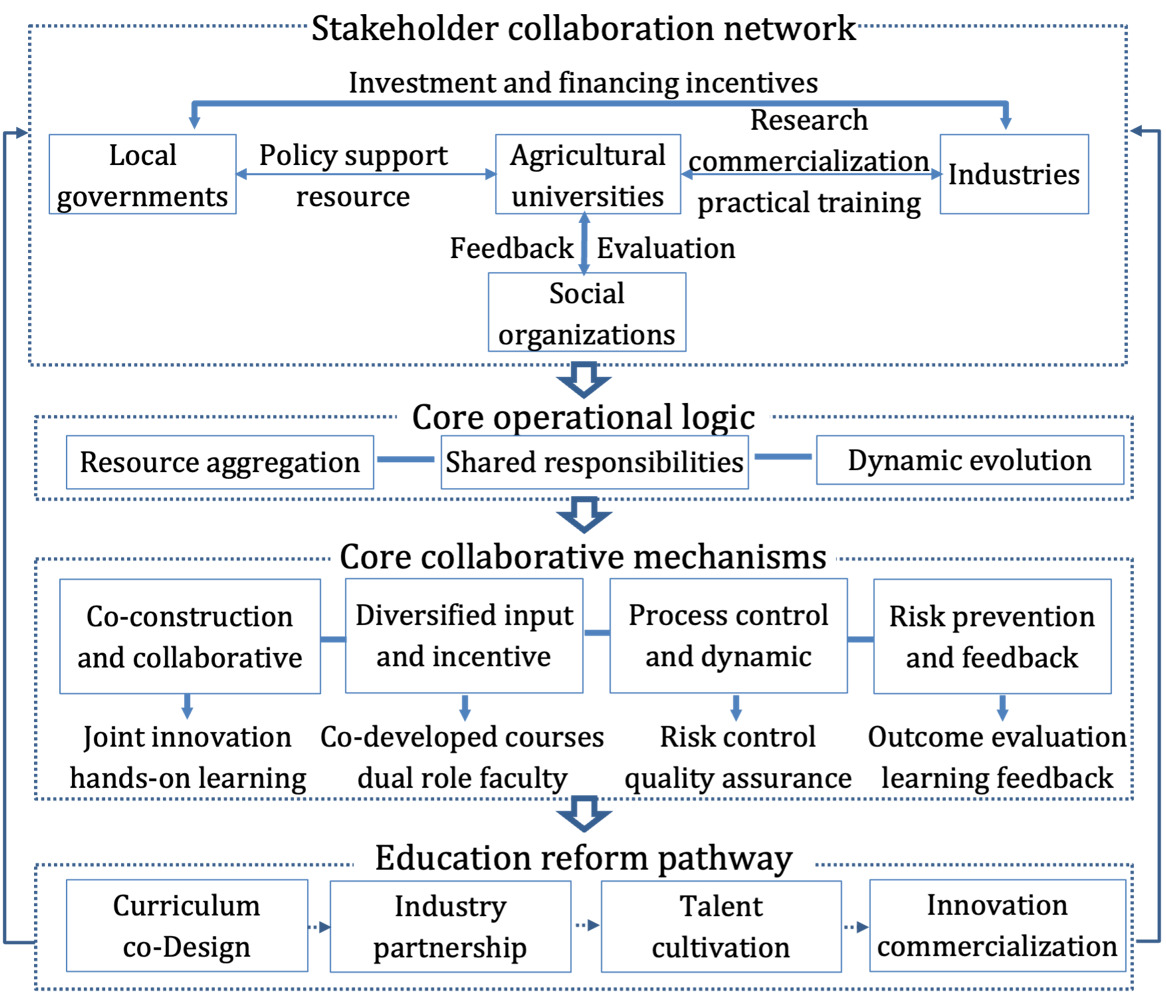
Selective coding examines the relationships among the conceptual categories identified in open coding (Table 2) and collaborative mechanisms derived from axial coding (Table 3) to construct a theoretical model. The resulting model of the successful programs of industry–education integration at QAU is illustrated in Figure 1. It features a four-layer nested structure, comprising (1) a stakeholder collaboration network, (2) a core operational logic, (3) core collaborative mechanisms, and (4) an education reform pathway. This model demonstrates how universities, governments, industries, and social organizations create value together and sustain continuous reform.
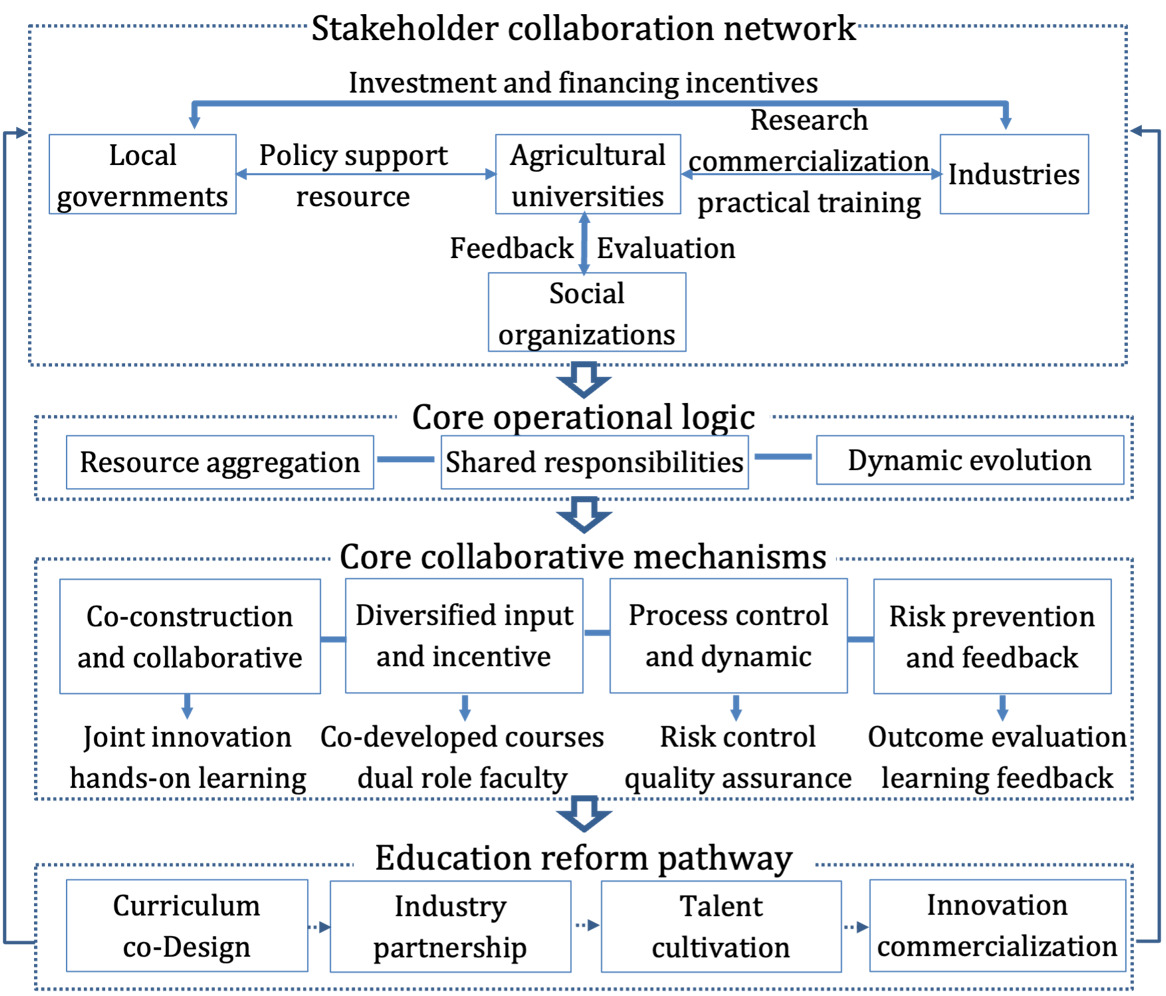
Four core actors are involved in the stakeholder collaborative network, each playing a distinct yet complementary role: Local government agencies, agricultural universities, industries, and social organizations form an interdependent collaboration network (Leydesdorff and Etzkowitz 1996). Local governments coordinate policy and resources and provide institutional and financial support (Yang 2014; Dou 2018; Bi 2020). Agricultural universities serve as the central node of knowledge creation and talent cultivation by aligning education and research with industry needs. They contribute through education and research, developing talent and technologies that feed into local industries while maintaining their disciplinary strengths and institutional diversity (Gu et al. 2024). Industries act as demand-side partners by participating in curriculum development, practical training, and technology transfer (Yang and Li 2016). They drive technological advancement and provide platforms for applying knowledge in practice (Qiu and Ma 2019; He and Guan 2023). Social organizations facilitate communication, feedback, and evaluation (Su et al. 2018; Wei et al. 2020). Together, these stakeholders form a collaborative system that enables continuous adaptation and innovation across higher education and industrial development.
At the core operational logic level, three guiding principles define how the system functions. Resource aggregation promotes the integration of information, capital, and institutional support through shared platforms and policy incentives (Zhao and Ma 2021; Yu and Shi 2023). Shared responsibilities reflect the complementary roles of different actors. The experience at QAU suggests that long-term collaboration is more sustainable when stakeholders share common goals in talent cultivation, innovation, and regional development. Dynamic evolution ensures adaptability to changing policies, technologies, and market conditions. These principles enable the system to renew its internal mechanisms and maintain sustainable partnerships (Bi 2020).
At the mechanism level, the four collaborative mechanisms identified through axial coding transform structure into practice. First, at QAU, the co-construction and collaborative education mechanism integrates curriculum design, applied research, and experiential learning to better align academic programs with industry needs. This mechanism combines theoretical instruction, laboratory training, case-based teaching, and on-site practice, significantly enhancing students’ practical skills and employability. QAU and industries work together in curriculum development, student participation in real-world projects, and joint talent cultivation, helping bridge the gap between educational offerings and labor market demands. For example, this approach has been implemented through close partnerships with industry to establish the Modern Industrial College for Intelligent Agricultural Machinery, develop industry-oriented curricula, and introduce industry-involved mentorship programs for students. More than 50 practice-oriented courses have been developed at QAU with industry participation, directly addressing evolving job requirements and emerging technologies in the agricultural sector.
Second, the diversified input and incentive alignment mechanism at QAU ensures a stable flow of resources by coordinating contributions from governments, industries, and the university in funding, infrastructure, and staffing. More broadly, this mechanism promotes shared investments and coordinated incentives among universities, industries, and governments. These contributions support teaching platforms, faculty development, and research resources, thereby advancing structural reform within the education supply system. In practice, this mechanism is reflected in multi-source resource integration, including more than 50 cooperation agreements, 13 innovation platforms, and 59 practical training sites jointly supported by government, industry, and the university. The experience of QAU demonstrates that stable collaboration depends on formal organizational arrangements, effective resource-sharing mechanisms, and sustained institutional support.
Third, the process control and dynamic adjustment mechanism improves operational efficiency at QAU by enabling adaptive curriculum refinement with industry participation. This mechanism operates through an integrated “research–teaching–training” system and industry-linked projects. It establishes clear task division, quality monitoring, and real-time feedback to ensure effective implementation. At QAU, integrated project-based training and industry-linked teaching platforms demonstrate how structured collaboration can strengthen students’ practical skills and enhance employability.
Fourth, the risk prevention and feedback evaluation mechanism promotes accountability and continuous improvement by combining risk assessment, outcome evaluation, and external review. This mechanism improves the stability and long-term effectiveness of collaboration by clarifying responsibilities, establishing evaluation metrics, and incorporating third-party evaluation. QAU has established monitoring systems, including project management, teaching evaluation, and curriculum feedback, to support continuous improvement in teaching quality and industrial relevance.
At the education reform pathway level, the model supports supply-side reform through four interconnected pathways that link education and industry. These pathways include curriculum co-design, industry partnership, talent cultivation, and innovation commercialization. Curriculum co-design focuses on incorporating industrial needs into academic programs. This improves the relevance of teaching and ensures that curricula remain responsive to changes in the labor market. Industry partnership emphasizes deep collaboration between universities and industries in teaching, research, and practice. Joint programs, industry-led projects, and collaborative laboratories help students connect theoretical knowledge with real-world applications. Talent cultivation aims to build a comprehensive training system that integrates classroom learning, practical training, and professional guidance. Through industry internships, research participation, and interdisciplinary collaboration, students gain hands-on experience and develop the professional competencies required by emerging industries. Innovation commercialization strengthens the transformation of research outcomes into practical applications. By promoting the commercialization of scientific discoveries and incorporating industry feedback into teaching reform, QAU establishes a continuous feedback mechanism that supports educational improvement and innovation renewal. Through this system, QAU has transformed more than 700 research outputs into practical applications, contributing over 13 billion RMB in industrial output.
The theoretical model (Figure 1) identified in this study aligns closely with both the Quadruple Helix Innovation Ecosystem and Mode 3 knowledge-production framework. The key contribution of this study is to demonstrate how these two perspectives converge, which links stakeholder collaboration with adaptive knowledge co-production and sustained educational reform.
The Quadruple Helix framework explains the multi-stakeholder structural foundation of industry–education integration and how key stakeholders interact within the system. The QAU case reflects the Quadruple Helix proposition that innovation emerges through the coordinated interaction of universities, industries, governments, and broader social organizations rather than through isolated bilateral partnerships (Carayannis and Campbell 2010; 2011; 2012; Stephens 2025). As shown in Figure 1, these stakeholders perform complementary roles in policy support, resource coordination, practical training, research commercialization, feedback, and evaluation, forming a collaborative ecosystem characterized by resource aggregation, shared responsibility, and dynamic evolution (Ashby 1958; Wang and Zhuo 2016; Huo 2019; Naseer et al. 2025). Within this ecosystem, stakeholders are interconnected through shared resources, collaborative technological innovation, and joint efforts to support social and economic development (Chen 2018; Yang and Wu 2019; Du 2019).
While the Quadruple Helix framework explains the structural relationships among stakeholders, the Mode 3 knowledge-production framework clarifies the internal logic of adaptive and iterative knowledge co-production. The Mode 3 framework conceptualizes knowledge generation as occurring within a networked and adaptive innovation system that connects universities, industries, governments, and society (Carayannis and Campbell 2006). By comparison, Mode 1 represents the traditional model of knowledge production, which is discipline-based and academically driven. It focuses on theoretical knowledge within established scientific fields and is primarily conducted within universities and research institutions (Wu 2021). In contrast, Mode 2 emphasizes applied and interdisciplinary research conducted in real-world contexts, where knowledge is generated through problem-solving and collaboration.
Consistent with the principles of Mode 3 knowledge production, the collaborative mechanisms at QAU emphasize cross-sector collaboration, adaptive learning, and iterative innovation, rather than relying solely on Mode 1 or Mode 2 approaches. In this model, innovative knowledge emerges through iterative interactions among teaching, practice, research, and industrial application, rather than through a linear university-to-industry transfer process. Knowledge is co-created, applied, and continuously refined through curriculum co-development, project-based learning, dual-role faculty participation, practical training platforms, and feedback-driven improvement (Carayannis and Campbell 2006, 2009). At QAU, the Mode 3 framework challenges conventional classroom-centered instruction by promoting knowledge co-creation through joint university–industry curriculum development, collaborative mentorship arrangements, faculty–industry partnerships, integrated training platforms, and student participation in real-world projects. As a result, education shifts from purely theoretical instruction toward experiential and practice-oriented learning. This model integrates human, technological, social, and cultural capital to foster collaborative innovation networks capable of adapting to evolving societal and industrial needs (Carayannis and Campbell 2009; Marchesani and Ceci 2025).
5. Key Drivers of Successful Industry–Education Integration Programs at Qingdao Agricultural University
Using grounded theory, this study identifies an innovation ecosystem that supports industry–education integration at QAU. This ecosystem helps bridge the structural gap between the rapid pace of industrial transformation and the comparatively slower adaptation of academia. Insights from this case study provide useful reference points for other agricultural universities seeking to implement coordinated industry–education integration strategies. This section summarizes five key dimensions that contribute to the success of the industry–education integration programs at QAU.
5.1. Establishing a Multi-Stakeholder Governance Mechanism for Industry–Education Integration
A multi-stakeholder governance structure can strengthen coordination among key participants in industry–education integration. Agricultural universities may consider developing regional industry–education integration alliances composed of government agencies, leading businesses, industry associations, local financial institutions, and faculty representatives. These alliances could form a governance committee responsible for conducting regular assessments of educational collaboration needs, issuing dynamic guidelines for discipline adjustment, and overseeing independent units for curriculum evaluation and outcome monitoring. Additionally, joint industry–education offices could be established to manage student internships and coordinate corporate mentorship resources.
5.2. Advancing Competency-Oriented Curriculum Reform
Curriculum reform is a key pathway for translating industrial demand into educational practice. Because curriculum design connects academic instruction and industry skill requirements, universities are encouraged to co-develop practice-oriented courses with industry partners. These courses can embed real-world tasks and project-based cases into classroom instruction to enhance students’ problem-solving skills. Industry-linked curriculum design also helps ensure that teaching content remains aligned with emerging technologies and evolving job requirements. Dedicated funding programs may further incentivize industry participation in course design and evaluation. In addition, teaching outcomes could be integrated into faculty performance reviews and promotion criteria to incentivize instructional innovation and industry-aligned teaching.
5.3. Developing a Dual-Track Faculty Talent Development Mechanism
Faculty development is another key enabling condition, particularly where teaching quality depends on the integration of academic expertise with industrial practice. Faculty industry experience helps ensure curriculum relevance and effective classroom instruction. Universities may consider establishing a faculty rotation or secondment program that allows selected instructors to spend time working in industry. Such arrangements can deepen faculty understanding of current technologies and professional practices. At the same time, industry professionals can be invited to serve as course advisors or practice mentors, co-leading project-driven and case-driven instruction. Combining academic supervision with industry-based mentoring can strengthen practice-oriented talent cultivation and improve the relevance of professional training.
5.4. Building an Integrated, Project-Based Education Platform
Effective integration of industry, education, research, and application requires strong platform support. Universities may leverage existing research stations and innovation centers to build comprehensive student project platforms. These platforms could include agricultural innovation experiments, product development initiatives, market expansion projects, and digital agriculture applications. Encouraging students to participate in one or two industry-led projects during their studies, with project outcomes counted toward capstone projects, course grades, or competition submissions, can further strengthen practical skills. Such project-based platforms also help integrate research achievements into teaching activities and commercialization pipelines.
5.5. Fostering a Collaborative Culture and Shared Values
Industry–education integration is not only about structural arrangements but also cultural alignment. Agricultural universities are encouraged to cultivate a shared culture of collaboration through initiatives such as “collaborative education months” and enterprise culture workshops. These activities can bring together faculty, students, and industry partners for joint course evaluations, innovation competitions, and community-based projects. By encouraging co-education, shared responsibility, and collective development, universities can strengthen the social foundations of collaborative learning. Classroom instruction may also incorporate industry standards, corporate ethics, and principles of sustainable agriculture, reinforcing the broader societal mission of higher education.
6. Conclusion
This study applied grounded theory to examine the collaborative mechanisms underlying successful industry–education integration programs at Qingdao Agricultural University (QAU) in China. Through in-depth interviews and document analysis of eight representative programs, the study developed a multi-layered, practice-oriented theoretical model that explains how universities, industries, governments, and social organizations collaborate to support talent cultivation, knowledge production, and innovation in agricultural higher education.
The theoretical model developed in this study demonstrates the convergence of the Quadruple Helix Innovation Ecosystem and the Mode 3 knowledge-production framework. The Quadruple Helix perspective explains the structural relationships among universities, industries, governments, and society, highlighting the importance of multi-stakeholder collaboration in industry–education integration. Meanwhile, the Mode 3 framework explains the internal logic of adaptive and iterative knowledge co-production, emphasizing the dynamic interaction among teaching, research, and industrial practice. Together, these perspectives help explain how collaborative mechanisms at QAU support both institutional reform and continuous innovation in agricultural higher education.
The study identifies several key drivers that support the long-term success of industry–education integration initiatives. First, establishing a multi-stakeholder governance mechanism can strengthen coordination among government agencies, industries, and universities, ensuring stable institutional support and effective oversight of collaborative programs. Second, competency-oriented curriculum reform is essential for translating industrial demand into educational practice. Industry participation in curriculum design and evaluation helps ensure that teaching content remains aligned with emerging technologies and evolving job requirements. Third, developing dual-track faculty development mechanisms, such as faculty industry rotations and industry-based mentorship, can enhance the integration of academic knowledge with industrial practice. Fourth, integrated project-based education platforms provide students with opportunities to participate in real-world projects, strengthening practical training while facilitating the transformation of research outcomes into industrial applications. Finally, fostering a collaborative culture and shared values among universities, industries, and students helps sustain long-term cooperation and reinforces the broader social mission of agricultural education.
Despite these contributions, this study has several limitations. The selected cases represent relatively mature and high-performing programs, which may not fully capture the challenges faced by less-developed or emerging integration initiatives. Future research could conduct comparative studies across institutions with varying levels of development, incorporate broader cross-regional samples, and apply quantitative methods to evaluate the long-term impacts of industry–education integration on student outcomes and regional innovation systems.
Overall, this study provides empirical evidence and a theoretically grounded framework for understanding how industry–education integration can be effectively implemented in agricultural universities. By demonstrating how collaborative governance structures and adaptive knowledge-production mechanisms can operate in practice, the research offers valuable insights for advancing educational reform, strengthening talent cultivation systems, and supporting agricultural modernization and regional development.
About the Authors
Wulantuoya Bao is an associate professor in the Department of Agricultural and Forestry Economics and Management at Qingdao Agricultural University. Yangxuan Liu (corresponding author) is an associate professor in the Department of Agricultural and Applied Economics at the University of Georgia. Yuanyuan Liu is a lecturer in the Office of Academic Affairs at Qingdao Agricultural University.
Acknowledgments
The authors thank the interview participants and collaborating institutions for providing information, documents, and access that supported this study.
Funding
This work was supported by the Shandong Province Undergraduate Teaching Reform Research Project (Project Nos. M2023048 and M2025252).
Conflict of Interest
The authors declare no conflicts of interest.
AI Disclosure
ChatGPT (OpenAI) was used solely to assist with English-language editing and to improve the clarity and readability of the manuscript. It was not used in the study design, data collection, coding, analysis, interpretation of results, formulation of findings or conclusions, or development of the research methods. The authors reviewed and verified all AI-assisted text and take full responsibility for the manuscript.
Human Subjects Disclosure
This study received exempt determinations from Qingdao Agricultural University (IRB ID: QAUIRB2026NHR001) and the University of Georgia (IRB ID: PROJECT00014844). All participants provided informed consent before participation.