1. Introduction
Rising domestic and international demand for cheese and other manufactured dairy products due to steady increases in per capita consumption is expected to sustain continued expansion in US dairy processing over the next decade. This trend occurs even as per capita fluid milk consumption continues to decline (USDA 2021). In anticipation of this rising demand, US dairy processors have committed more than $11 billion in investments across over 50 new or expansion projects in 19 states between 2025 and 2028 (Dairy Processing, n.d.).
As the dairy industry grows, processors face mounting pressure to reduce greenhouse gas (GHG) emissions and improve overall environmental performance (Onwezen et al. 2021). In 2020, the Innovation Center for US Dairy launched the Net Zero Initiative (NZI), committing the industry to achieve net-zero emissions by 2050. Understanding how processors respond to NZI is essential to ensure the sector meets its sustainability goals while adapting to evolving market and regulatory expectations. While existing research has primarily focused on on-farm mitigation technologies (Mazzetto et al. 2025; Rotz et al. 2025) or on consumer preferences for low-carbon dairy products (Canavari and Coderoni 2020), relatively little attention has been given to how dairy processing firms themselves are responding to NZI-related transitions.
This study provides a qualitative assessment of how US dairy processors are navigating the transition toward lower GHG emissions, drawing on data from semistructured interviews. We find that processors are undertaking substantial efforts and increasingly positioning themselves not merely as intermediaries in the supply chain but also as strategic coordinators in the transition toward net zero. A tripartite cooperation model linking farms, processors, and downstream customers is emerging to coordinate emissions reductions from farm to retail, with retailers and food service companies actively investing in farm-level mitigation efforts.
At the same time, processors face significant challenges. These include inconsistencies across existing GHG accounting and reporting frameworks, the limited scalability and high upfront costs of mitigation technologies, a lag between technological development and industry needs, and disproportionate burdens on small producers. Despite these challenges, processors also identify several opportunities, including downstream customer collaboration, funding opportunities, and government regulation.
2. Methods and Sample Characteristics
From May to August 2025, we conducted semistructured interviews with senior executives from eight US dairy processors via Zoom or Microsoft Teams. Each interview lasted approximately 60–90 minutes. Although participation was voluntary, the sample of this highly concentrated industry was drawn primarily from Dairy Foods’ Top 100 Processor list (Berk 2024). The participating firms range in size from about 250 to more than 10,000 employees and collectively procure more than 10 percent of the total US milk supply.
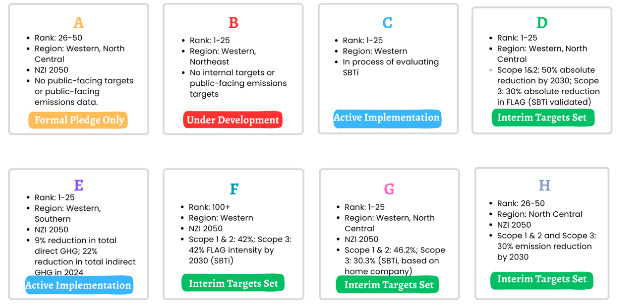
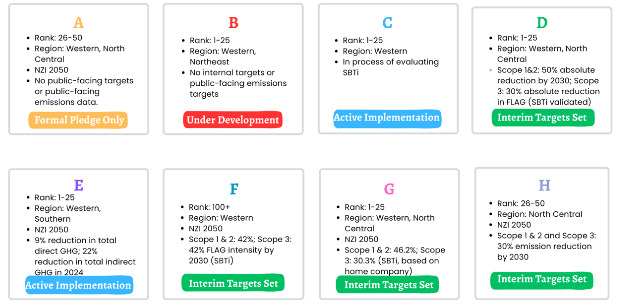
Figure 1 summarizes the profile of each processor. To preserve anonymity, specific details such as annual production volumes and employment figures are not reported. The eight processors operate facilities or subsidiaries in more than 18 states, with products distributed nationwide and exported to international markets. The sample of eight processors includes cooperatives, privately held companies, and publicly traded firms. More than 80 percent of the milk supplied to these processors is secured through long-term contracts, with the remainder sourced from spot markets.
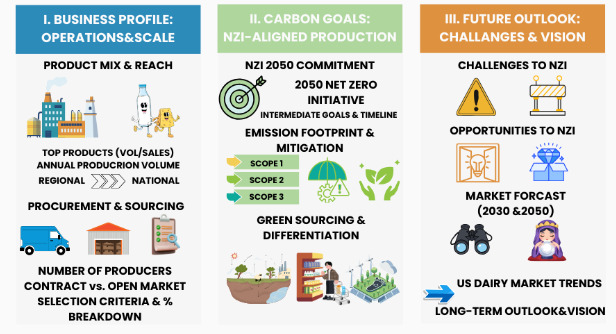
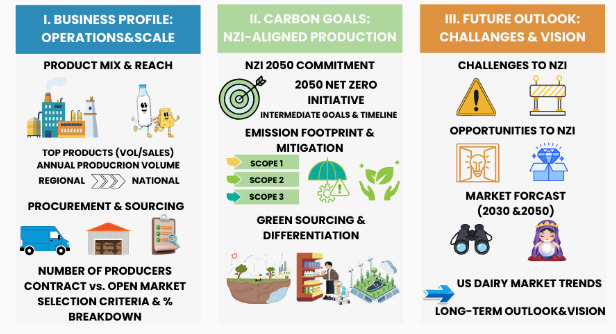
Interviewees were asked a predetermined set of open-ended questions and were encouraged to elaborate on issues they considered most important. The interview protocol focused on three core themes: (1) business profiles, (2) emissions reduction goals and implementation challenges, and (3) anticipated future developments in the dairy processing sector. Figure 2 summarizes the interview questions.
Institutional Review Board approval was obtained prior to data collection. Interview transcripts were analyzed using MAXQDA 2024 qualitative analysis software (VERBI Software 2024). We systematically coded the transcripts to identify recurring themes and patterns across interviews. Initial codes were developed deductively from the interview guide and were subsequently refined inductively as new themes emerged.
3. Themes from Processor Interview
Before delving into the detailed results, it is useful to review the GHG Protocol Corporate Standard, which is commonly used in emissions discussions. Under this framework, emissions are categorized into three scopes: Scope 1 (direct emissions), Scope 2 (indirect emissions from purchased energy), and Scope 3 (all other indirect emissions). For dairy processors, Scope 1 emissions primarily result from on-site fuel combustion, particularly natural gas used in heat-intensive operations such as pasteurization, cleaning, heating, ventilation, and cooling. Scope 2 emissions stem from purchased electricity, which powers energy-intensive equipment including refrigeration systems, compressors, pumps, motors, and production lines, with refrigeration accounting for most cooling demand. Scope 3 emissions, which represent roughly 70–90 percent of a processor’s total carbon footprint, are the most difficult to mitigate and are dominated by on-farm sources such as enteric methane, feed production, and manure management (Siegl et al. 2023).
Prior research on corporate sustainability efforts emphasizes firm-level motivations such as regulatory compliance, stakeholder pressure, financial access, and moral commitment (Freeman et al. 2010; Drempetic et al. 2020; Kim et al. 2025). Our interviews reveal these familiar drivers but also suggest a less prominent motivation in the literature: supply chain preservation. Processors B and C framed decarbonization not primarily as a response to external pressure but as essential to ensuring the long-term viability of their milk supply. This perspective positions processors as coordinators of a broader decarbonization ecosystem rather than simply responding to their own institutional environment.
In this section, we discuss five key themes obtained from the interviews: (1) the current state of NZI commitments, (2) ongoing efforts to reduce emissions within and beyond the processing plants, (3) perceived challenges to emissions reduction, (4) perceived opportunities that shape decarbonization progress, and (5) perspectives on long-term industry trajectories.
3.1. NZI Commitments Across Dairy Processors
Processors varied in how they formalized and implemented NZI commitments. As shown in Figure 1, seven of the eight processors have formally aligned with the US Dairy NZI. Four have established interim reduction targets, three of which have been validated by the Science Based Targets initiative (SBTi), providing third-party verification and signaling stronger accountability. One additional firm (Processor C) is currently seeking SBTi validation, while the remaining processors are in earlier planning stages or have not yet articulated formal interim goals. A central challenge across firms is that Scope 3 emissions lie largely beyond their direct operational control. Even among those with interim targets, clear implementation pathways remain under development.
Differences in processors’ net zero approaches appear to reflect three primary factors: geographic location, parent company origin, and stage of corporate development. Regional variations are particularly evident between California and other states, where differences in regulatory expectations and implementation timelines shape firms’ approaches. Processors based in California generally exhibit stronger leadership in sustainability, in part due to the state’s more stringent regulatory framework. Additionally, some states provide targeted funding for innovation in agriculture, energy, and related sectors (Minnesota Department of Agriculture, n.d.), with some investments becoming financially self-sustaining over time (Garbe et al. 2023).
Parent company origin also matters. European multinational firms typically operate under stricter regulatory and reporting requirements than processors headquartered in the United States (European Commission 2021). As a result, some US subsidiaries that currently lack interim emissions reduction targets for 2030 are expected to adopt commitments established by their European parent companies.
The development stage further differentiates net zero approaches. Processors undergoing rapid expansion often face constraints in securing milk supplies for new facilities, limiting their ability to set near-term emissions targets, as firms prefer to set goals that are realistic and achievable within a defined timeframe. However, they are beginning to develop measurable targets. As Processor B noted, establishing measurable 2030 targets is important for tracking key performance indicators. In contrast, larger and more established firms in the sample have made substantial progress in decarbonizing facilities and engaging with their supplying farms. Some have assigned multiple executives to sustainability governance across areas such as on-farm programs, processing operations, carbon accounting, and water stewardship.
3.2. Current Efforts to Reduce GHG Emissions
Seven of the eight dairy processors reported substantial progress in reducing Scope 1 and 2 emissions, with some committing to reductions of 20–40 percent by 2030. Main strategies include adopting renewable energy from sources such as on-site solar installations, upgrading energy efficiency, and electrifying heating and cooling systems. For example, Processor G has installed on-site solar infrastructure, though further expansion is currently limited by space constraints. The high cost of renewable natural gas also restricts decarbonization options. As a result, Processor G focuses on optimizing production processes and engaging in virtual power purchase agreements (VPPA), which allow firms to purchase renewable energy credits and claim emissions reductions without directly receiving the electricity (Noorfatima et al. 2025).
Efforts to reduce Scope 3 emissions vary substantially across processors. Common approaches used by firms in our sample include investing in anaerobic digesters and providing financial or technical support for on-farm emissions measurement and reporting. Anaerobic digesters can capture over 90 percent of methane emissions from manure and generate revenue through biogas sales and carbon credits. Processor E reported that around 20 percent of its milk supply comes from farms equipped with anaerobic digesters, which substantially reduce methane emissions from manure management. However, the upfront cost for each installation ranges from $1 million to $4 million, with payback periods typically exceeding 10 years (Lombardi et al. 2020).
Programs under the US Dairy NZI also support Scope 3 mitigation efforts. For example, Processor H reported that approximately 40 supplying farms have participated in NZI-supported feed production practices. Another processor noted that methane-inhibiting feed additives can reduce emissions per cow by 20–30 percent (Hristov et al. 2015), but adoption remains limited due to cost and implementation constraints.
3.3. Challenges and Constraints in Advancing Decarbonization
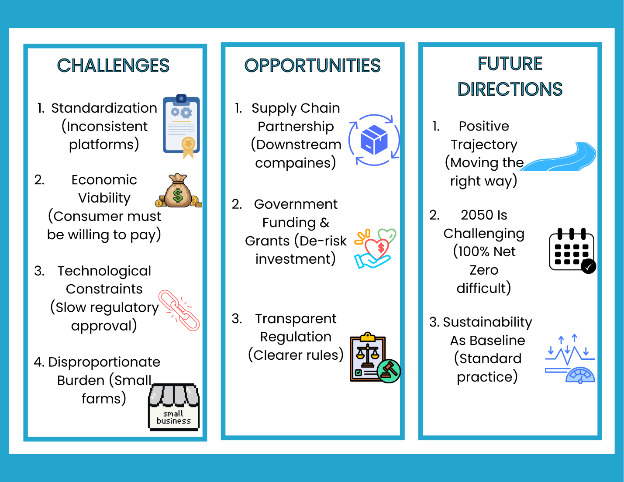
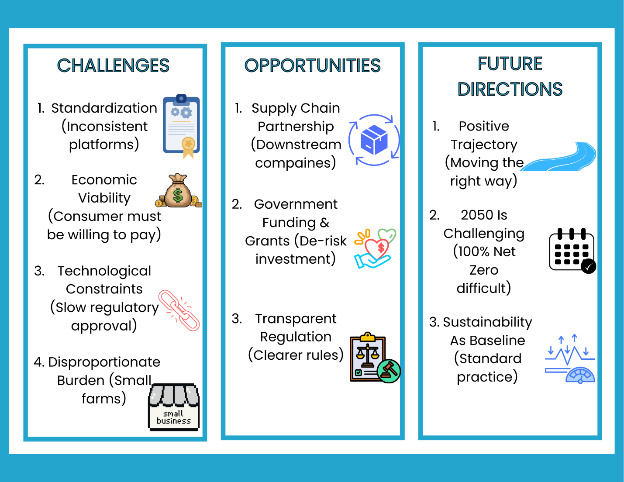
Despite growing momentum, processors face substantial challenges in pursuing NZI-aligned reductions. Four recurring themes emerged from the interviews (Figure 3, left panel): standardization, economic viability, technological constraints, and disproportionate burden on small producers.
3.3.1. Challenge 1: Standardizing Measurement and Reporting
The dairy industry relies on multiple reporting platforms and inconsistent accounting frameworks, making objective, “apples-to-apples” comparisons of emissions difficult (Murphy et al. 2016). Respondents unanimously called for harmonized accounting tools and standardized industry methods to enable consistent, transparent, and verifiable tracking and reporting of emissions across the supply chain.
Several respondents emphasized that navigating multiple, often conflicting reporting frameworks is time-consuming. Processor A, an active participant in sustainability networks, explained, “We have to fill out 10 different reports in 10 different formats.” This administrative duplication diverts time and resources away from actual reduction efforts.
Attribution of emissions reductions presents another barrier, particularly for anaerobic biodigesters. When digester owners claim carbon credits for renewable natural gas, processors are unable to count those reductions in their Scope 3 inventories. This restriction on double-attribution disincentivizes processors from investing in biodigester projects. Interviewees also noted that limited federal incentives further weaken such investments. Processor B stated, “Today we are not going to be using any biodigesters, nor will we be financially supporting any biodigesters from our side.”
For processors with international operations, measurement inconsistencies create further complications. Firms rely on different measurement tools, such as the Cool Farm Tool (Cool Farm Alliance, n.d.) for global operations and Farm ES (National Milk Producers Federation 2025) for US farms, each based on different methodologies. These differences generate outputs that are not directly comparable, complicating internal evaluations and executive-level reporting.
3.3.2. Challenge 2: How to Remain Economically Viable?
A recurring message across interviewees was that emissions reductions must be financially sustainable to be viable over the long term. As Processor D noted, entering a negative-profit scenario would severely limit the industry’s ambition and investment capabilities. Processor C estimated that achieving net zero would require billions of dollars in investments. These costs, processors emphasized, would ultimately be reflected in product prices, requiring consumers to pay a premium for lower-carbon dairy products.
However, consumer demand for sustainability does not always translate into purchasing behavior. PwC’s (2025) “Voice of the Consumer” Survey across 28 global markets finds that while more than 80 percent of respondents express concern about climate change, only 44 percent are willing to pay more for environmentally friendly food. Processor C remarked, “It’s a really simple answer to all of this, and it’s money. It’s simple, but it’s not easy.”
Financial feasibility is also shaped by broader economic conditions. In the United States, relatively low natural gas prices weaken incentives for biogas production, whereas higher natural gas prices in Europe improve the financial returns of anaerobic digestion projects.
3.3.3. Challenge 3: Systemic and Technological Constraints
Processors noted that new emission-reduction technologies frequently face lengthy regulatory approval timelines that can extend for several years. Scientific research and modeling updates can also lag behind industry needs, creating a situation in which “new research arrives 10 years after you need it” (Processor G). These delays contribute to a sense of “fighting against time” and increase the risk that processors may fall behind on both their intermediate and long-term net-zero goals. For instance, Processor F noted that scaling enteric methane-reducing feed additives is a major technological challenge, particularly for large dairy operations. Many methane-inhibiting additives are still in early development stages, and existing solutions are often costly, designed for small-scale use, or incompatible with the feeding systems used in high-capacity operations (Beauchemin et al. 2020). Large herds with automated feeding systems require technologies that can be integrated efficiently and safely. As the processor explained, it is not feasible for employees to manually handle 50-pound bags of additives in a commodity barn; instead, additives must be incorporated upstream at the mill level.
3.3.4. Challenge 4: Disproportionate Burden on Small Farms
Processors consistently noted that regulatory complexities place a disproportionate burden on small farms, which often lack the technical expertise and managerial capacity to navigate licensing, reporting, and compliance requirements. Processor E observed, “There’s a lot of red tape within any project we do… the farms don’t have teams of engineers to deal with regulation.” Several processors emphasized that, despite making meaningful contributions to climate mitigation, farmers are often insufficiently recognized or financially rewarded, particularly when emissions reductions fall outside conventional carbon accounting boundaries. Additionally, many suggested that overly complex procedures discourage farm-level engagement and limit the scalability of emissions reduction efforts. According to interviewees, simplifying administrative processes and lowering entry thresholds (e.g., financial and technical barriers) would make sustainability programs more accessible to a broader range of producers, thereby improving both inclusiveness and overall supply chain efficiency.
3.4. Opportunities
This subsection synthesizes key opportunities processors believe will shape future competitiveness and sustainability outcomes (Figure 3, middle panel).
3.4.1. Opportunity 1: Downstream Investment in on-Farm Sustainability
Downstream companies, particularly high-profile brands with their own climate commitments, are increasingly investing directly in upstream sustainability initiatives, often facilitated through processor-led coordination. Interviewees noted that these partnerships provide essential funding for capital-intensive on-farm mitigation projects. Through shared investment models for technologies such as anaerobic digesters and precision nutrition management systems, farmers face less financial risk when adopting new technologies. Several processors emphasized that these partnerships also leverage corporate reputation and market influence, strengthening social and market signaling and reframing sustainability from a compliance requirement into a competitive differentiator.
Processor H described a related approach focused on inset projects in which emission reductions are accounted for within the company’s own supply chain rather than generating credits for external sales. The processor has begun working directly with customers on insetting projects targeting enteric methane reductions through feed additives. These efforts rely on third-party measurement, reporting, and verification to ensure credibility and compliance with established carbon agreements. In these arrangements, milk producers receive compensation through direct payments tied to verified mitigation outcomes.
3.4.2. Opportunity 2: Government Incentive Programs
Government funding was consistently identified as essential for advancing net zero goals by offsetting the high upfront costs of decarbonization technologies. Processors emphasized that high capital requirements, long payback periods, and relatively low US natural gas prices often make such investments financially unviable without public support. Processor C noted, “Any funding that helps improve practice will help accelerate this process.” By reducing financial risk and improving expected returns on investment, incentive programs make it more feasible for processors to adopt decarbonization strategies that align environmental objectives with economic constraints. For example, Processor E reported receiving support from a state energy commission to gradually reduce reliance on natural gas by integrating heat pumps that enhance filtration and heat recovery.
Beyond processing facilities, respondents highlighted a range of federal and state programs that support on-farm innovation. Interviewees emphasized that public funding availability directly motivates producer participation in GHG reduction efforts. One processor explained, “Producers called and asked if there’s money on the table—how can they get involved? How can I monetize [in this sense] what I’m doing?” Another processor noted participation in federal partnership programs that support manure management technologies facilitated on-farm adoption of technologies.
At the federal level, interviewees pointed to programs such as the Regional Conservation Partnership Program (USDA-NRCS n.d.), which provides funding for solutions to natural resource challenges on agricultural land. At the state level, California’s grant programs under California Climate Investments (California Department of Food and Agriculture, n.d.) were cited as examples of initiatives that allocate substantial funding to dairy methane-reduction efforts, including alternative manure management and dairy digester research and development to support on-farm adoption of emissions-reducing technologies. These examples illustrate the types of public incentives respondents viewed as instrumental in improving the financial feasibility of reducing emissions, addressing upstream Scope 3 emissions, and promoting coordination across farms.
3.4.3. Opportunity 3: Regulation
Processors noted that regulation can help create a more balanced competitive environment by establishing minimum emissions reduction standards across the supply chain. Several processors pointed to the European experience, where carbon pricing makes emissions an explicit component of financial decision-making. While many processors expressed a preference for voluntary action, others argued that mandatory regulation may be necessary to prevent free riding and maintain industry-wide momentum. Processor G, for instance, advocated for combining incentives with regulatory pressure, stating, “We need carrots and sticks—things that help us and things that push us.”
3.5. Perception of the Industry’s Future Direction
Processors generally expressed cautious optimism about the trajectory of sustainability within the dairy sector. Many observed that industry-wide engagement has increased substantially in recent years and that current efforts represent meaningful progress toward long-term climate goals. Although progress remains uneven and policy uncertainty persists, respondents felt that the sector is gathering pace and moving in the right direction. According to Processor E: once society evaluates dairy based on affordable, nutrient-dense protein delivered with improving emissions intensity, its comparative advantage will become more widely recognized. At the same time, several processors also acknowledged that achieving complete net zero by 2050 will be highly challenging, requiring not only sustained investment but also major technological breakthroughs, particularly in enteric methane reduction and scalable farm-level solutions. However, there are examples of agricultural community efforts addressing these farming challenges. In California, for instance, California Climate & Agriculture Network (“California Climate & Agriculture Network,” n.d.) supports sustainable dairy management practices (Brillinger 2024), while California Dairies Inc. promotes, supports and shares several sustainable practices among producers (California Dairies, Inc., n.d.).
Several processors identified consumers and customers as key drivers of progress toward NZI. However, some emphasized that sustainability needs to shift from a consumer-facing differentiator into a fundamental operational requirement embedded within standard practice. Processor D, for example, compared environmental performance with established milk quality metrics, such as somatic cell counts and standard plate counts, that are nonnegotiable criteria for market participation. This processor strongly opposed carbon-intensity pricing models that apply premiums to lower-emission milk, arguing that products with identical nutritional profiles should not be differentiated in ways that create guilt-based consumer choices. Instead, they contended that sustainability should operate as an industry-wide baseline, similar to pasteurization, where compliance is essential for long-term competitiveness rather than a short-term marketing strategy. This perspective, echoed by several interviewees, reframes net zero alignment as a structural expectation of the dairy sector and suggests that future policy and market systems will need to support sustainability as an integrated industry norm rather than a differentiating feature.
Finally, processors stressed that net zero should not be viewed as an endpoint but rather as one component of a resilient, equitable, and enduring dairy ecosystem. They advocated for research and policy frameworks that integrate carbon metrics with social and economic measures, ensuring that climate action reinforces rather than competes with farm viability and rural community stability.
4. Conclusion
This study provides insight into how US dairy processors are trying to move toward net zero. Many processors have become the de facto organizers of decarbonization across farms, plants, and customers. However, they are doing so in a system that has inconsistent accounting and reporting standards, limited financial feasibility, technological immaturity, and disproportionate burden on small farms. These observations are in line with Ni et al. (2025), who note that these methodological inconsistencies have slowed industry-wide decarbonization.
A clear need is to standardize the information process. Interviewees repeatedly mentioned spending time and resources converting the same information across incompatible reporting frameworks. Without a shared framework, processors are not able to benchmark, nor are customers and stakeholders able to verify claims, and the sector is unable to provide credible progress toward 2050.
Processors also described the dual challenge of responding to evolving scientific models while operating within supply chain structures that often prioritize short-term cost competitiveness over long-term climate performance. Despite these constraints, processors are actively developing adaptive strategies and have identified several opportunities to accelerate industry-wide decarbonization, including downstream collaboration, federal support such as investment tax credits, state-level cost-share grants, and regulatory mechanisms. Notably, many interviewees framed the net zero commitment within a broader conception of farming sustainability that includes farmer livelihoods, intergenerational succession, and animal welfare rather than treating emissions reductions as an isolated objective.
From a policy standpoint, establishing unified, industry-wide GHG accounting and reporting standards emerges as a critical priority. More broadly, advancing the dairy sector’s transition toward net zero will require coordinated policy, investment, and research efforts that integrate environmental ambition with the economics and social realities of dairy production. In addition, positioning sustainability as an industry baseline, rather than a market differentiator, may be essential to ensuring that progress in climate initiatives is credible and durable across the value chain.
Two limitations warrant consideration. First, the sample focuses on large dairy processors, primarily among the top 100 US firms. While this reflects industry concentration, it may not capture the perspectives of small processors with more limited access to capital and technical expertise. Second, voluntary participation in interviews may introduce self-selection bias, as processors with stronger sustainability commitments may have been more likely to participate.