1. The Dairy Farmer’s Decision
Alex operates a conventional dairy farm in Minnesota. Alex has observed the ongoing consolidation of the dairy industry for many years, and concerns about the future viability of the operation have intensified due to rising feed costs and volatile milk prices. At the same time, several neighboring producers have transitioned to organic production and now receive substantially higher milk prices. Having observed these changes and become increasingly concerned about the farm’s profitability, Alex is considering whether transitioning to organic production could improve the financial viability of the operation. However, Alex knows from neighboring producers that transition requires a multiyear commitment involving changes in production practices, certification and compliance costs, and potentially higher operating expenses before the farm becomes certified and can receive the higher organic price. Before deciding, Alex has reached out to your agricultural consulting firm for advice. “Some of my neighbors seem to be doing quite well after transitioning, while others have struggled,” Alex explains. “I am not sure whether transitioning is the right decision for my farm.”[1]
To advise Alex on this decision, you should be familiar with concepts related to dairy farm profitability and investment analysis. Specifically, Alex would like to understand the costs associated with transitioning to organic production, how production costs and revenues differ between conventional and organic systems, and whether the higher price for organic milk can offset the costs incurred during the transition period and generate positive returns over time. Evaluating these questions requires considering the timing of costs of benefits, the value of future returns, and the uncertainty surrounding future market conditions.[2]
2. The Economic Environment for Dairy Producers
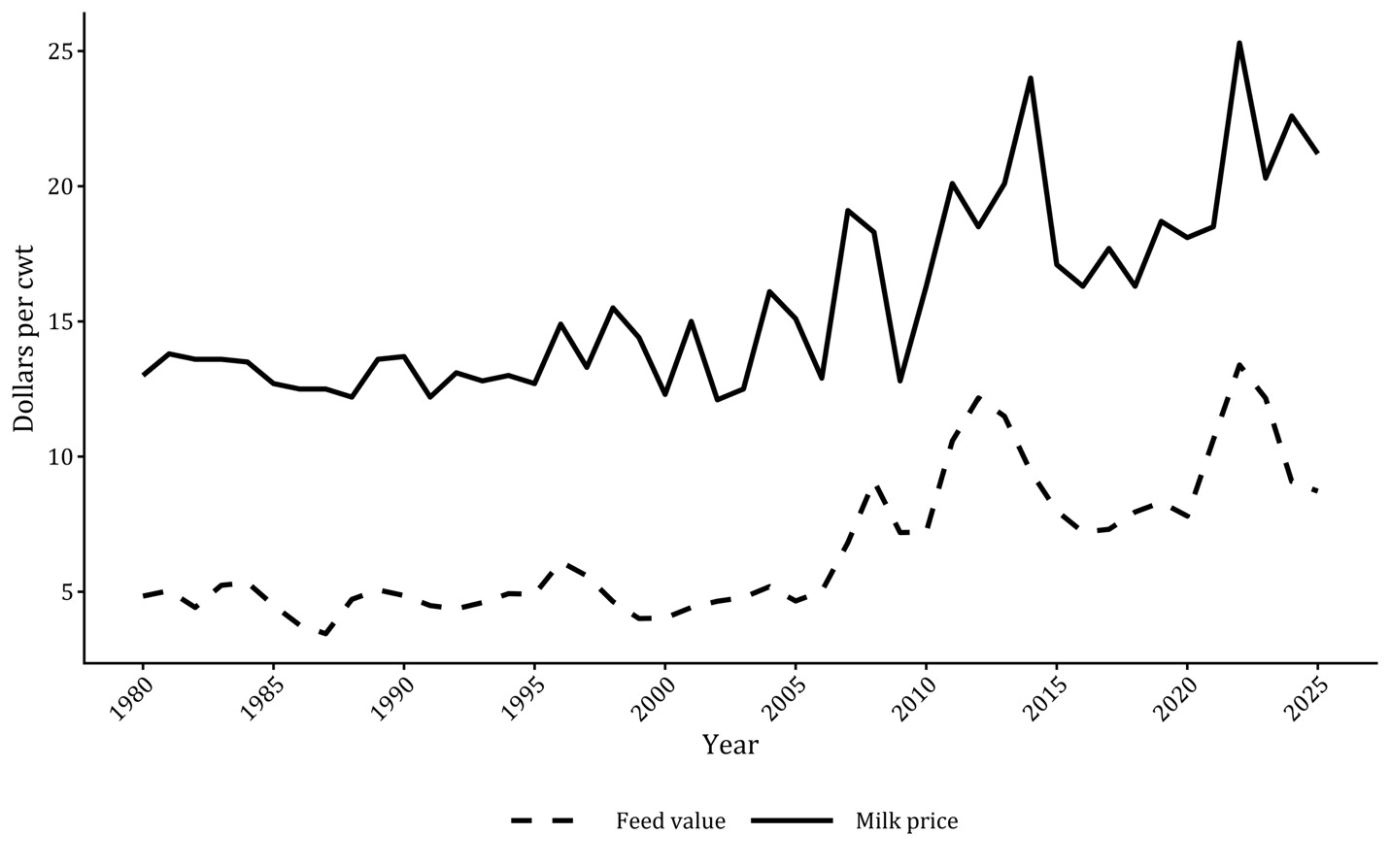
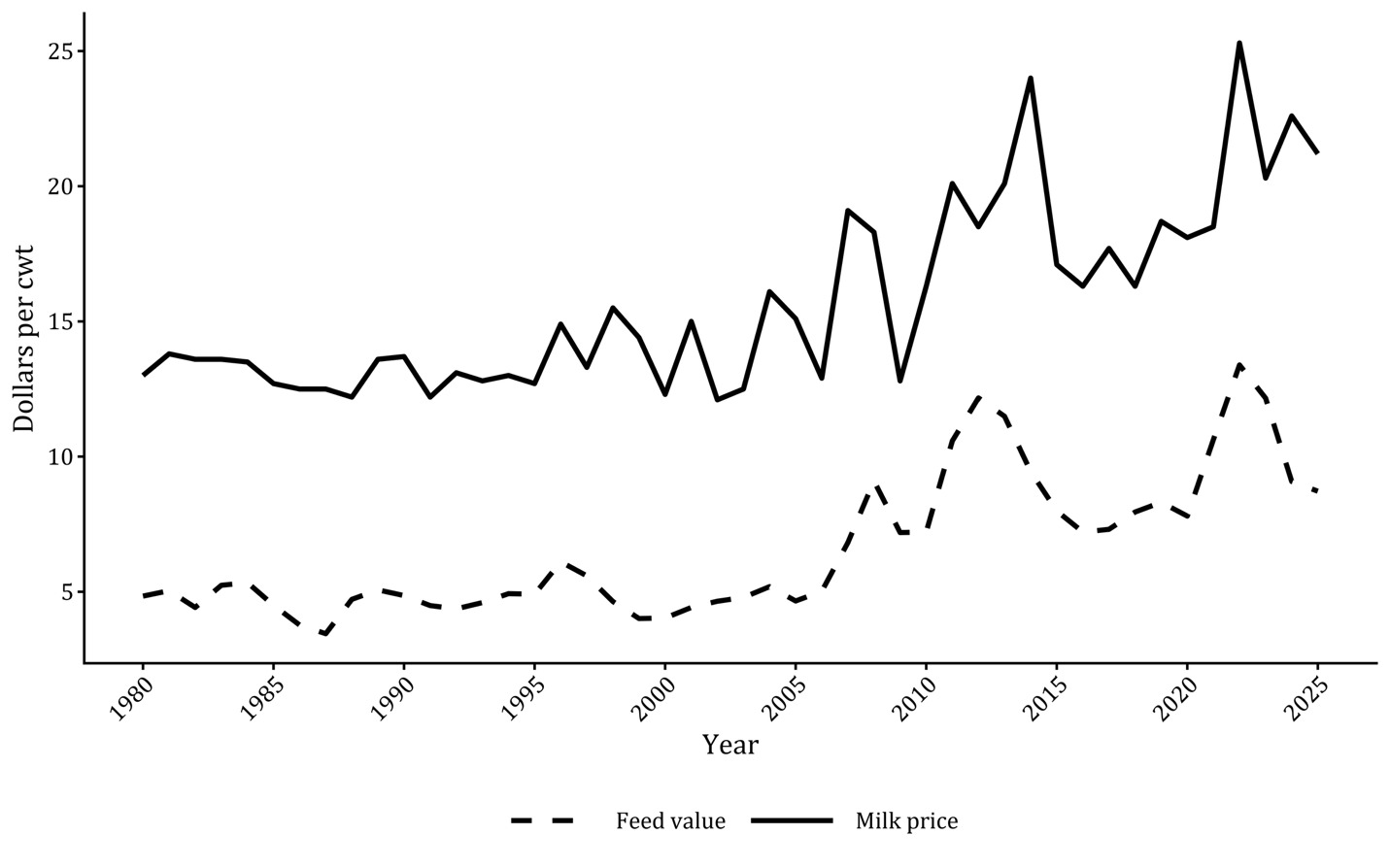
Dairy farmers operate in a challenging economic environment characterized by fluctuating milk prices and changing input costs. Although milk prices are determined within the framework of Federal Milk Marketing Orders, they remain responsive to changing supply and demand conditions. Over time, these changing market conditions have contributed to substantial variation in milk prices (USDA-ERS 2026a). Figure 1 illustrates these substantial fluctuations in milk prices and feed costs over time, highlighting the uncertain economic environment faced by dairy producers. Feed costs are the largest component of dairy production expenses (USDA-ERS 2026b), making the relationship between the volatile milk prices and increasing feed costs a key determinant of a dairy farm’s profitability. The sharp increase in feed prices during 2007–2008 was associated with rising energy prices and biofuel expansion, while elevated prices between 2011 and 2014 reflect strong global demand for feed grains and weather-related supply shocks (Ali and Vocke 2009; Wright 2014). More recently, feed prices increased sharply in 2021 and 2022 as supply chain disruptions following the COVID-19 pandemic coincided with strong global demand, particularly from China (USITC 2022).
In recent decades, the US dairy industry has undergone significant structural change, with fewer operations producing more milk as productivity gains and technological adoption have increased the advantages of larger-scale operations (MacDonald et al. 2020; Gillespie, Njuki, et al. 2024; McFadden and Raff 2026). MacDonald et al. (2020) show that although consolidation has occurred nationwide, cost pressures have disproportionately affected small dairy farms in the Midwest and Northeast regions. Furthermore, evidence from 2016 suggests that organic producers realized higher net returns per hundredweight of milk than similarly sized conventional dairy farms (MacDonald et al. 2020). These findings suggest that organic production may offer an alternative strategy for maintaining farm viability, particularly for smaller dairy operations facing increasing competitive pressures in the consolidating conventional sector. This potential is reinforced by continued growth in the demand for organic food products (Organic Trade Association 2026), driven in part by consumer preferences for healthier and more environmentally sustainable production practices (Gundala and Singh 2021; Raszap Skorbiansky 2025). However, the increasing popularity of plant-based alternatives—such as almond, soy, and oat milk (Asif et al. 2026; Stewart et al. 2020)—introduces additional competition and uncertainty regarding the future demand for dairy products.
The combination of these trends creates a complex decision environment for dairy farmers: While organic production offers the potential for higher revenues, it also involves higher costs and greater uncertainty. Much of this uncertainty also stems from the cost and availability of organic feed. Organic feed markets operate on a smaller scale than conventional feed markets, with production and trade occurring in lower volumes and often concentrated in specific geographical regions (Hadachek et al. 2022).[3] As a result, organic feed prices are generally more susceptible to production shocks and market volatility. For example, adverse weather conditions affecting a major organic feed-producing region may reduce supply and increase prices across a substantial portion of the market (Delbridge 2013). Higher production costs are also associated with lower productivity in many organic systems (McBride et al. 2015). Organic crop yields are typically lower than conventional yields because restrictions on synthetic fertilizers, pesticides, and herbicides can make nutrient management, weed control, and pest management more difficult. In a large meta-analysis, de la Cruz et al. (2023) found that organic crop yields are approximately 25 percent lower on average, while more recent evidence suggests a persistent yield gap of at least 18.4 percent across crops and climates (Seufert et al. 2012). Similarly, organic dairy farms generally produce less milk per cow because organic standards require greater reliance on grazing and forage-based feeding systems and less use of energy-dense feed concentrates (Hardie et al. 2014).[4] In response to higher feed costs and input constraints, many organic dairy farms rely more heavily on homegrown feed and pasture-based systems, although feeding strategies vary across farms and regions (Delbridge 2013). For example, farms in the Corn Belt and Midwest rely more on homegrown feed, whereas Western operations depend more heavily on purchased inputs (Gillespie, Raszap Skorbiansky, et al. 2024).
Although organic dairy production involves higher costs, these are partially offset by the price premiums for organic milk relative to conventional milk. Consumers cannot verify the organic attribute of milk themselves. Therefore, labels such as the USDA Organic seal help build consumer trust in organic products and support a higher willingness to pay for them (Van Loo et al. 2011). Organic milk prices are typically determined through contracts linked to conventional milk prices, with an added premium for organic production (Hadachek et al. 2022), which ties organic prices to broader dairy market conditions and exposes them to similar price risks. Although the magnitude of the premium varies with market conditions, Carlson and Jaenicke (2016) find that organic milk premiums were relatively persistent between 2004 and 2010 and among the highest of all organic product premiums. Periods of expansion in organic dairy production can increase supply and place downward pressure on premiums. Moreover, in regions with more processors, farmer cooperatives may have greater flexibility to switch buyers and negotiate higher premiums, whereas in markets with fewer processors, limited buyer options can allow processors to exert market power (Hadachek et al. 2022).
The uncertainty surrounding both costs and prices highlights the importance of evaluating the transition decision over multiple years rather than focusing on a single production season. In this case, you will advise Alex, a dairy farmer considering whether to transition from conventional to organic production. Although organic milk typically commands a price premium, transitioning requires changes in production practices, higher operating costs, and a certification period during which milk cannot be sold as organic. Alex wants to determine whether the potential long-term benefits of organic production are sufficient to justify these costs and risks. The framework presented in the following sections provides a structured approach for evaluating this question. As in many real-world investment decisions, some relevant information may be uncertain or unavailable, requiring you to make and justify reasonable assumptions when assessing the financial feasibility of transitioning to organic dairy production.
3. Organic Transition Decision Framework
The decision to transition to organic production is inherently a multiperiod investment problem. Although the farmer makes the decision to switch production systems at a single point in time, its profitability depends on the stream of revenues and costs realized over multiple periods. At any given point in time, a conventional farmer faces expected revenues and costs under the existing production system. The decision to adopt organic production therefore depends on comparing the expected stream of revenues and costs under organic production to those under continued conventional production over a planning horizon.
A critical component of this decision is the transition period required for organic certification. During this period, farmers must adopt organic production practices but are unable to market their milk at the organic price. As a result, they incur higher production costs while continuing to receive conventional milk prices. Evaluating these alternatives therefore requires quantifying the differences in revenues and costs across production systems over time. To do so, the farmer considers net returns per unit of production under each production system, which summarize the relationship between milk prices and production costs:
NRt=Pt−Ct,
where is the net return per hundredweight (cwt) of milk in year is the milk price per cwt of milk, and is the production cost per cwt of milk. Once annual net returns are calculated, the cost of transition can be measured as the difference between the net return from remaining conventional and the net return from operating as a transitioning farm during the transition period:
ΔNRTRt=NRTRt−NRCt,
where denotes annual net returns during the transition period and denotes annual net returns under conventional production in year Negative values of indicate that the farm earns lower net returns during the transition period than it would have earned by remaining conventional. Similarly, the long-run benefit of organic certification can be measured as the difference between the net return from certified organic production and the net return from remaining conventional:
ΔNROt=NROt−NRCt,
where represents annual net returns per cwt of milk under organic production. Positive values of indicate that organic production generates higher annual net returns than conventional production.
These annual differences can then be aggregated and discounted to evaluate the overall financial viability of transitioning to organic production. Because the transition decision involves costs and benefits that occur over multiple years, the farmer must account for the timing of these cash flows. To assess feasibility of transitioning, the farmer compares the present value of expected benefits and costs over time. Let denote the discount rate. A higher discount rate places less weight on future benefits and costs, while a lower discount rate places greater value on future outcomes. Therefore, the profitability of organic transition depends not only on the magnitude of expected costs and benefits but also on how the farmer values returns received in the future.
Transitioning is profitable if the discounted benefits from higher organic revenues exceed the discounted costs of transitioning:
T∑t=1ΔNROt(1+r)t≥T∑t=1ΔNRTRt(1+r)t,
where indexes time, denotes the planning horizon, and is the discount rate. This framework allows the farmer to evaluate how production decisions depend on key factors such as price premiums, cost differences, and the discount rate. The farmer will choose to adopt organic production if the discounted benefits exceed the associated discounted variable costs:
T∑t=τΔPOt(1+r)t⏟ benefit of transitioning ≥τ−1∑t=0ΔCTRt(1+r)t+T∑t=τΔCOt(1+r)t⏟ variable cost of transitioning ,
where represents the first period in which organic certification is achieved,[5] at which point milk can be marketed as organic. The term captures the price premium received after certification. The term reflects the higher variable production costs incurred during the transition period, such as reliance on purchased organic feed and adjustments associated with adopting organic practices, and denotes the variable cost differences that persist thereafter, once certification is achieved and the farm operates under a fully organic production system.
The decision framework can be adjusted to distinguish partial and full organic transition strategies along two dimensions: the length of the transition period and the variable cost structure after certification. National Organic Program guidelines suggest that farmers may choose between two transition strategies: a partial transition, in which only the herd is converted, or a full transition, in which both land and herd are converted to organic practices (Coffey and Baier 2012). Partial transition allows the farm to access the organic price premium sooner, but it may involve higher post-certification operating costs due to continued reliance on purchased organic feed. In contrast, full transition delays certification because both herd and land must be converted, but it may reduce long-run variable costs by allowing greater on-farm feed production. In practice, organic regulations allow multiple pathways for transitioning dairy operations. For example, producers may transition livestock and land simultaneously, transition them in stages, or take advantage of provisions that allow dairy animals to transition during the final year of land conversion under certain conditions (Coffey and Baier 2012). Because these alternatives differ in certification timing and feed requirements, they may generate different streams of costs and benefits over time.
One reason that producers may choose to delay herd transition until the final year of land transition is that crops and forage produced on land in its third year of transition can be used to feed transitioning dairy animals (Coffey and Baier 2012). This may reduce reliance on purchased organic feed and lower the costs associated with transitioning the herd. More generally, Delbridge (2013) notes that transition decisions may also depend on whether dairy farms produce their own feed or rely primarily on purchased feed. As a result, farmers face a trade-off between accessing the organic milk premium sooner and potentially reducing long-run feed costs through a more extensive transition strategy. The farmer will choose to transition fully rather than partially if the discounted long-run gains from full organic production exceed the additional discounted transition costs required to convert land and herd:
T∑t=τFOCPOt−CFOt(1+r)t⏟ long-run gain from lower operating costs from organic certification of land and herd ≥τFO−1∑t=0ΔCTRt(1+r)t⏟ short-term additional cost of transitioning the land and herd ,
where is the variable cost under partial transition in period is the variable cost under full transition in period is the first period in which the farm receives the organic premium under full transition, and is the additional transition cost incurred in period when pursuing full transition rather than partial transition. The left-hand side represents the discounted long-run cost savings from full transition, while the right-hand side represents the additional discounted costs incurred during the longer transition period. This condition highlights the trade-off between alternative transition strategies and depends critically on the length of the transition period, the timing of certification, and the resulting stream of costs and benefits. Evaluating this condition in practice, however, requires information on strategy-specific costs and revenues over time, which is often unavailable in real-world data.
While the available data capture many production and overhead expenses, they do not capture all costs associated with organic certification. These may include learning organic management practices, modifying production systems to comply with organic regulations, maintaining additional records, undergoing annual inspections, and paying certification fees (Delbridge 2013). Certification costs vary across farms and certifying agencies and may be partially reimbursed through cost-share assistance programs (Hadachek et al. 2022; Carlson et al. 2023). Because information on these transition-specific costs is not consistently available in the data, the estimated transition costs should be interpreted as capturing differences in observed operating costs and revenues across production systems rather than the full economic cost of transition.
4. Advising the Dairy Farmer: Evaluating the Transition Decision for Alex
Alex has asked for your recommendation regarding whether transitioning to organic dairy production is financially feasible. To develop a recommendation, you will use the decision framework introduced in Section 2 together with historical information on prices, costs, and production outcomes for conventional and organic dairy farms. Because detailed information on farms undergoing transition is rarely observed, some components of the analysis must be approximated using available data from the University of Minnesota Center for Farm Financial Management. As is often the case in applied economic analysis, this requires making assumptions using historical patterns, evaluating their implications, and carefully interpreting the resulting estimates.
Given these data limitations, your objective is not simply to perform calculations but to use the available evidence to assess whether the expected benefits of transitioning are likely to outweigh the associated costs and risks. Throughout the exercise, consider how assumptions about costs, future benefits, and the timing of returns influence your conclusions. By the end of the case, you should be prepared to explain not only whether you would recommend transition to Alex but also the conditions under which that recommendation might change. Alex can then combine your advice with other considerations before making the final decision.
About the Authors
Albulena Basha Yildirim (abasha@iastate.edu), Graduate Research and Teaching Assistant, Department of Economics, Iowa State University.
Acknowledgments
The author gratefully acknowledges Peter F. Orazem, Jason Bergtold (AEEE editor), and the anonymous reviewers for their constructive comments and valuable feedback, which greatly improved this case.
AI Disclosure
The author has nothing to disclose.